
Scholarship Balance Scorecard Promoting Access to Higher Education for Students from Low-Income Families
No Poverty
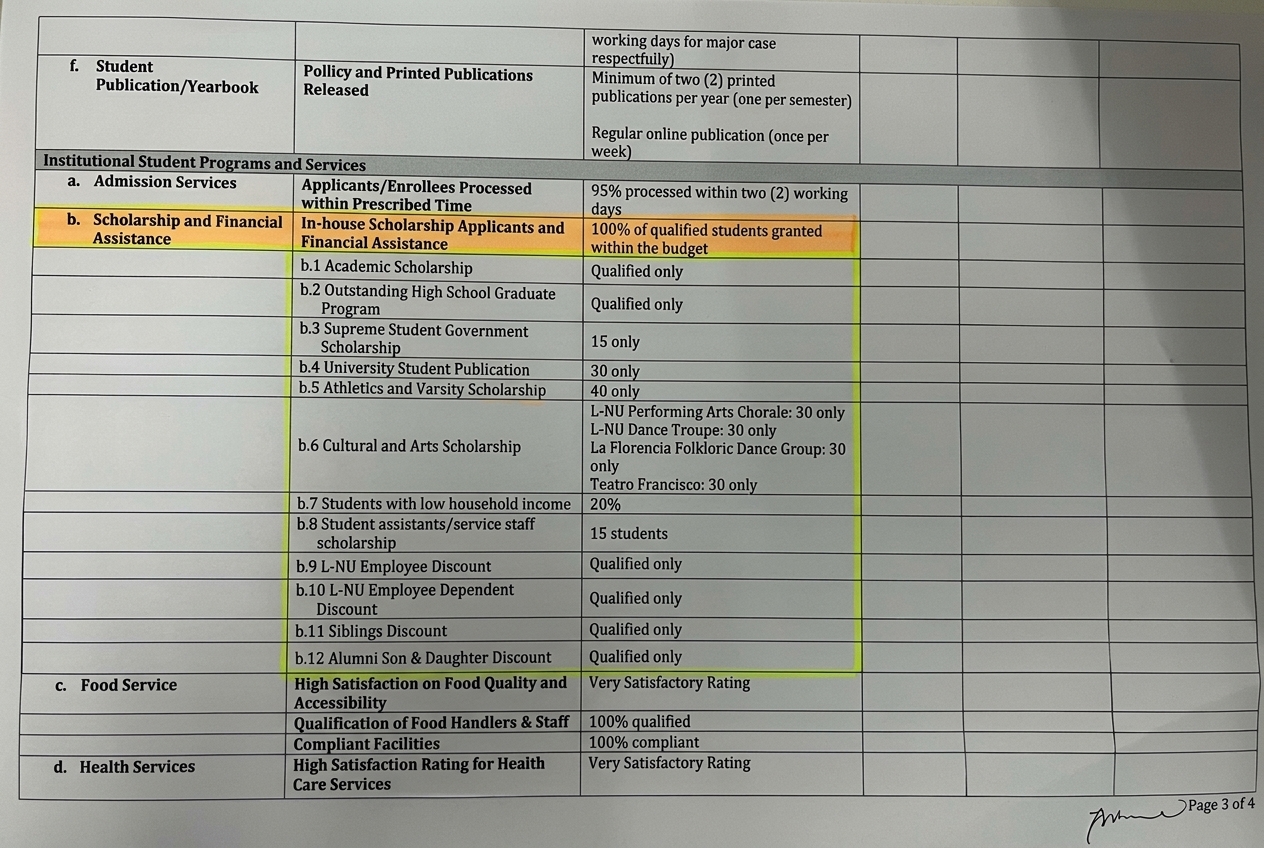
Lyceum-Northwestern University (L-NU) is committed to promoting equitable access to higher education by providing opportunities for students from economically disadvantaged households, including those belonging to the lower-income segments of the population. Through its Scholarship Balance Scorecard, the University monitors and evaluates the implementation of its scholarship and financial assistance programs to support students who may otherwise face financial barriers to pursuing a college education.
The Scholarship Balance Scorecard serves as a monitoring and assessment mechanism for the University’s scholarship initiatives, helping track scholarship distribution, beneficiary participation, and the provision of financial assistance. Through this system, L-NU seeks to ensure that scholarship opportunities reach qualified students who require financial support, particularly those from low-income families. The University’s target is set above and beyond the minimum requirements and the average benchmark among Higher Education Institutions (HEIs) in Region I, demonstrating its commitment to exceeding established standards in providing access to higher education for students from low-income households. The initiative also provides a basis for evaluating the University’s efforts to make educational opportunities more accessible and identifying areas where scholarship assistance can be strengthened.
By maintaining scholarship programs and monitoring their implementation through the balance scorecard, L-NU supports students who experience financial difficulties and encourages their continued enrollment and completion of their chosen academic programs.
The impact of L-NU’s Scholarship Balance Scorecard is reflected in its contribution to monitoring and strengthening the University’s financial assistance initiatives for students from low-income households. By tracking scholarship beneficiaries and assessing the distribution of available assistance, the University can better evaluate whether its programs are reaching students who need financial support. This monitoring mechanism also helps identify gaps in scholarship coverage and opportunities to improve the accessibility and distribution of educational assistance. By setting targets beyond the minimum requirements and average HEI benchmarks in Region I, L-NU demonstrates its commitment to going beyond baseline expectations and continuously improving its scholarship initiatives. Through these efforts, L-NU helps reduce socioeconomic barriers to higher education, promotes more inclusive student admissions, and provides disadvantaged students with greater opportunities to pursue their academic goals.