
E.P.I.C.: Community-Based Climate Change Education, Energy Conservation, and Environmental Sustainability Program
Climate Action

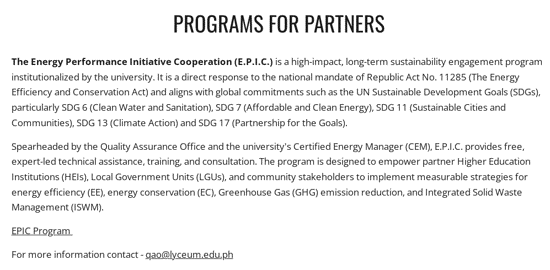
Lyceum-Northwestern University (L-NU) demonstrates its commitment to climate change education and environmental sustainability through the Energy Performance Initiative Cooperation (E.P.I.C.), a high-impact, long-term sustainability engagement program institutionalized by the University. The initiative responds to the national mandate of Republic Act No. 11285, otherwise known as the Energy Efficiency and Conservation Act, and supports the University’s commitment to the United Nations Sustainable Development Goals (SDGs), particularly SDG 6 (Clean Water and Sanitation), SDG 7 (Affordable and Clean Energy), SDG 11 (Sustainable Cities and Communities), SDG 13 (Climate Action), and SDG 17 (Partnerships for the Goals).
Spearheaded by the Quality Assurance Office and the University’s Certified Energy Manager (CEM), E.P.I.C. provides free, expert-led technical assistance, training, consultations, and educational activities for partner Higher Education Institutions (HEIs), Local Government Units (LGUs), and community stakeholders. Through these activities, the program promotes awareness and understanding of energy efficiency, energy conservation, greenhouse gas (GHG) emission reduction, and Integrated Solid Waste Management (ISWM). It also equips participating institutions and communities with practical knowledge and strategies to address environmental challenges, reduce resource consumption, and adopt more sustainable operational practices.
In relation to climate change education, E.P.I.C. emphasizes the importance of understanding the environmental impacts of excessive energy consumption, greenhouse gas emissions, and improper waste management. Through technical discussions, capacity-building activities, and knowledge-sharing sessions, participants are encouraged to adopt climate-conscious practices and implement measurable initiatives that contribute to climate change mitigation and impact reduction. These efforts also strengthen institutional and community awareness of the importance of environmental responsibility, resource conservation, and collective action in addressing climate-related challenges.
The impact of L-NU’s E.P.I.C. program extends beyond the University by building the capacity of partner institutions, local government units, and community stakeholders to respond to climate change through practical and sustainable interventions. By providing free technical assistance and educational opportunities, the initiative helps participants understand the relationship between energy consumption, greenhouse gas emissions, waste management, and climate change. The knowledge and skills gained enable partner organizations to develop and implement energy-saving measures, reduce carbon emissions, improve waste management practices, and adopt more environmentally responsible operations. Furthermore, the program strengthens collaboration between the University and local stakeholders, encouraging shared responsibility in addressing climate risks and environmental concerns. Ultimately, E.P.I.C. contributes to a more climate-conscious community, supports local climate change mitigation efforts, and advances L-NU’s commitment to building resilient and sustainable communities.